CPAP vs. Mandibular Advancement Devices: Which Is Right for You?
If you have been diagnosed with obstructive sleep apnoea (OSA), you are likely weighing up your treatment options. Two of the most widely used are CPAP — the clinical gold standard — and mandibular advancement devices (MADs), a dental sleep medicine intervention. Understanding what the evidence says about each can help you make an informed decision alongside your clinical team.
🌬️ CPAP: The Gold Standard
The current gold standard treatment for OSA is continuous positive airway pressure (CPAP), which acts by creating a positive pressure that keeps the airway open during sleep.
This is reflected in UK clinical guidance.
CPAP is recommended as a treatment option for adults with moderate or severe symptomatic OSAHS in NICE’s technology appraisal guidance (TA139).
What CPAP does well:
Produces the greatest measurable reductions in apnoea-hypopnoea index (AHI)
CPAP is associated with significantly higher lowest oxygen saturation levels compared to MAD
Backed by decades of clinical trial data across all severity levels of OSA
The limitation:
Despite CPAP’s effectiveness in treating OSA, there is low patient satisfaction and compliance with CPAP for various reasons, ranging from cost to patient reluctance to sleep with a mask on their face.
🦷 Mandibular Advancement Devices: The Dental Alternative
A MAD is a custom-fitted oral appliance, provided by a dentist trained in sleep medicine, that repositions the lower jaw forward during sleep to reduce airway collapsibility.
If a person with moderate or severe OSAHS is unable to tolerate or declines to try CPAP, NICE recommends considering a customised or semi-customised mandibular advancement splint as an alternative.
What the evidence shows:
MADs consistently reduced AHI from baseline and improved Epworth Sleepiness Scale scores and snoring. In head-to-head comparisons, MADs generally yielded smaller reductions in AHI than CPAP but achieved comparable improvements in symptoms and quality of life, with higher nightly adherence.
Compliance with treatment was 1.1 hours per night significantly lower with CPAP than MAD, which could explain why though efficacy in AHI reduction is better with CPAP, no significant differences are shown for quality of life, cognitive, and functional outcomes.
Titratable MAD had a similar impact to CPAP on major patient-centred outcomes including sleepiness and quality of life, and treatment adherence and preference were largely in favour of MAD.
Custom vs. ready-made:
Custom-made MADs showed marginally greater AHI reduction than ready-made MADs, have longer wearing times and higher adherence rates, and generally have fewer side effects.
At Whitland Dental Co, we provide only custom-fitted, titratable devices.
⚖️ How Do They Compare?
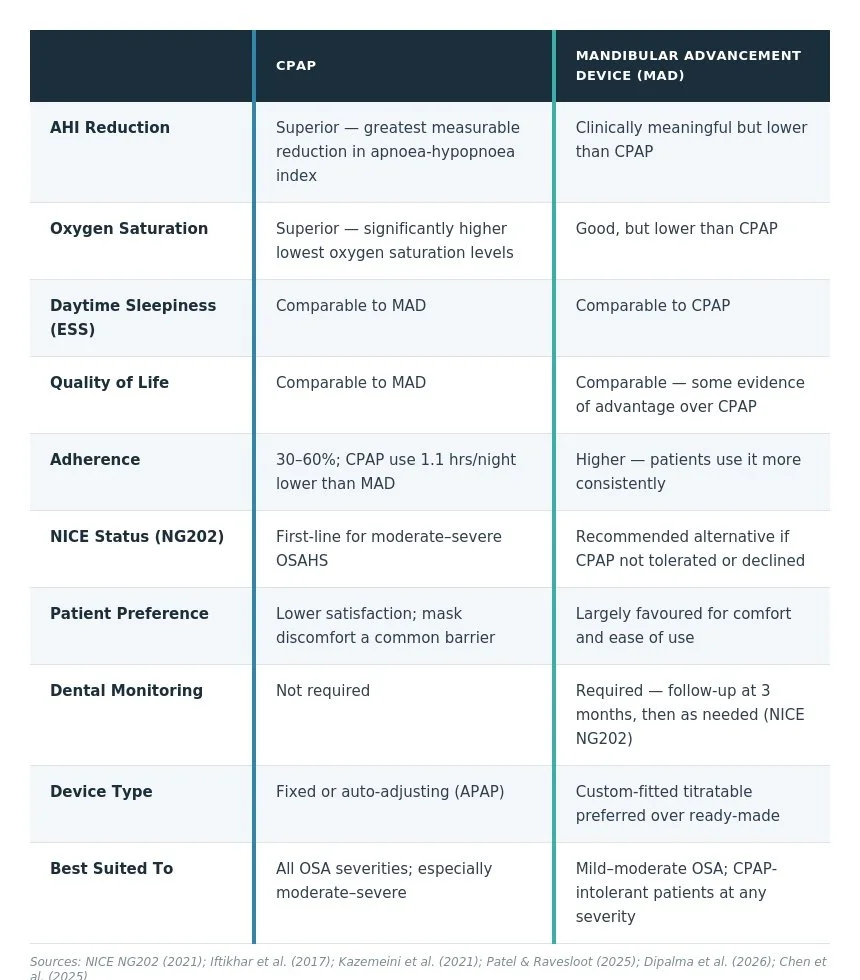
CPAP vs. MAD
🩺 The Bottom Line
CPAP still remains the gold standard for the treatment of OSA and should continue to be recommended as a treatment for OSA. MAD can be used as adjunctive treatment or as a treatment for those who cannot readily access or do not prefer CPAP.
The most effective treatment is ultimately the one a patient will use consistently. If CPAP has not worked for you — or you would like to explore your dental options — a MAD fitted and monitored by a trained dental sleep medicine clinician is a NICE-supported, evidence-based alternative.
📞 Book a sleep assessment at whitlanddental.co
References
Dipalma, G., Inchingolo, A. M., Mancini, A., Ferrara, I., Carpentiere, V., Palermo, A., & Inchingolo, F. (2026). Comparative efficacy of continuous positive airway pressure and mandibular advancement devices in the treatment of obstructive sleep apnea: A systematic review. Journal of Sleep Research, e70192. https://onlinelibrary.wiley.com/doi/10.1111/jsr.70192
Iftikhar, I. H., Bittencourt, L., Youngstedt, S. D., Ayas, N., Cistulli, P., Schwab, R., Durkin, M. W., & Magalang, U. J. (2017). Effects of CPAP and mandibular advancement device treatment in obstructive sleep apnea patients: A systematic review and meta-analysis. Sleep Medicine, 30, 7–14. https://pubmed.ncbi.nlm.nih.gov/29129030/
Kazemeini, E., Van den Bossche, K., Morlion, B., Verbraecken, J., & Carra, M. C. (2021). Health outcomes of continuous positive airway pressure versus mandibular advancement device for the treatment of severe obstructive sleep apnea: An individual participant data meta-analysis. SLEEP, 44(7), zsab015. https://academic.oup.com/sleep/article-abstract/44/7/zsab015/6119670
National Institute for Health and Care Excellence. (2021). Obstructive sleep apnoea/hypopnoea syndrome and obesity hypoventilation syndrome in over 16s (NICE guideline NG202). https://www.nice.org.uk/guidance/ng202/chapter/1-Obstructive-sleep-apnoeahypopnoea-syndrome
Patel, K., & Ravesloot, M. (2025). Efficacy of mandibular advancement devices in the treatment of mild to moderate obstructive sleep apnea: A systematic review. Dentistry, 5(4), 49. https://www.mdpi.com/2673-8937/5/4/49
Ramar, K., Dort, L. C., Katz, S. G., Lettieri, C. J., Harrod, C. G., Thomas, S. M., & Chervin, R. D. (2015). Clinical practice guideline for the treatment of obstructive sleep apnea and snoring with oral appliance therapy. Journal of Clinical Sleep Medicine, 11(7), 773–827. [via PMC8890605] https://www.ncbi.nlm.nih.gov/pmc/articles/PMC8890605/
Chen, Y., Zhang, J., Gao, X., & Almeida, F. R. (2025). Efficacy and adherence of different mandibular advancement device designs in treatment of obstructive sleep apnea: A systematic review and meta-analysis. Journal of Oral and Maxillofacial Surgery. https://www.sciencedirect.com/science/article/abs/pii/S0889540625000198