If you have been diagnosed with obstructive sleep apnoea (OSA), you may have been recommended positive airway pressure (PAP) therapy. Two of the most commonly prescribed options are CPAP and APAP. Both work by delivering pressurised air through a mask to prevent the airway from collapsing during sleep — but they do so in fundamentally different ways.
🌬️ What Is CPAP?
CPAP — continuous positive airway pressure — is the gold standard treatment for OSA.
It delivers a single, fixed level of air pressure throughout the night. This pressure is determined in advance, usually through a titration study, and remains constant regardless of your sleep position, sleep stage, or alcohol intake on any given night.
Key facts:
Pressure is set and does not change
Highly effective when used consistently
Well-supported by decades of clinical evidence
Considered first-line therapy for moderate to severe OSA
The adherence challenge: Despite its effectiveness, CPAP has a significant compliance problem.
Adherence rates range from 30–60%, and poor adherence is widely recognised as a significant limiting factor in treating OSA, leaving many patients at heightened risk for comorbid conditions, impaired function, and quality of life.
Common reasons for non-use include mask discomfort, claustrophobia, pressure intolerance, and air leaks.
Socioeconomic barriers, physical discomfort, and patient mistrust also contribute to low adherence rates.
⚙️ What Is APAP?
APAP — auto-adjusting positive airway pressure — dynamically adjusts treatment pressure in response to events detected automatically from a derived flow signal. Introduced in the 1990s, APAP quickly became a key tool in sleep clinics, initially serving as a faster alternative to manual titration for patients with OSA, and later also as a long-term treatment option.
Rather than delivering a fixed pressure, APAP continuously monitors your breathing in real time and increases or decreases the delivered pressure as needed — responding to snoring, flow limitation, hypopnoeas, and apnoeas as they occur.
Key facts:
Pressure adjusts breath-by-breath throughout the night
Particularly useful where pressure needs vary (e.g. due to weight changes, alcohol, sleep position)
Often used as an alternative to in-lab titration studies
May offer more comfort for those who struggle with consistently high fixed pressures
🔬 How Do They Compare? What Does the Evidence Say?
APAP and CPAP are overall comparable in terms of adherence, efficacy, and control of symptoms. However, concern remains that APAP offers less control of chronic health outcomes, such as blood pressure, kidney function, and glycaemic values.
Specifically:
A meta-analysis of 23 randomised controlled trials demonstrated no clinically significant difference in average hours of use in adults with OSA treated with APAP compared to CPAP.
An umbrella review of meta-analyses of randomised controlled trials, covering evidence from 2017 to 2025, identified CPAP as the most effective intervention for reducing apnoea-hypopnoea index (AHI) and daytime sleepiness in patients with OSA.
Titration studies are becoming less common, though they remain useful to define an APAP pressure range, meet insurance requirements, or assist in the appropriate choice of device and pressure settings in more complex cases.
A notable caveat regarding APAP:
A major issue is that APAP algorithms — which govern event detection and pressure adjustments — are proprietary and vary among manufacturers, making them poorly understood by clinicians. This lack of transparency impacts both the science, as research into these algorithms is severely limited, and patients, given the absence of robust real-world testing before these technologies are released for clinical use.
🩺 Who Is Each Device Best Suited To?
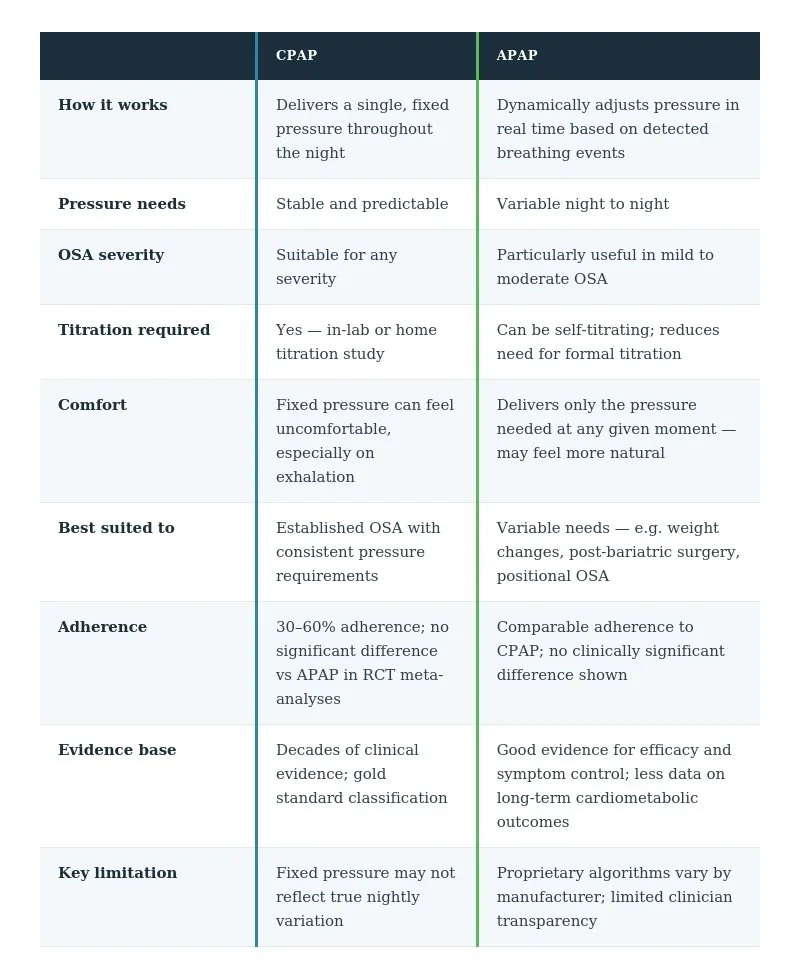
CPAP vs. APAP
BiPAP (bilevel positive airway pressure) should be considered in patients with sleep-disordered breathing associated with daytime hypercapnia, sleep-related hypoventilation, mixed obstructive and central apnoea events, or high-pressure requirements, or in those who cannot tolerate high expiratory pressures.
🦷 Where Does Dentistry Fit In?
PAP therapy is not the only evidence-based option for OSA. For patients with mild to moderate disease, or those who cannot tolerate a mask, custom mandibular advancement devices (MADs) — provided by a dentist trained in sleep medicine — offer a clinically validated alternative. At Whitland Dental Co, we can help assess which treatment pathway is most appropriate for you and work collaboratively with your medical team to ensure you receive the right care.
📞 Book a sleep assessment at whitlanddental.co
References
Abboud, M., Rotty, M. C., Palot, A., Cuvelier, A., Thong, T., & Pépin, J. L. (2025). Auto-adjusting positive airway pressure: The fine line between engineering and medicine. Sleep and Breathing. https://pmc.ncbi.nlm.nih.gov/articles/PMC12304072/
Costanzo, M. R., Khayat, R., Ponikowski, P., Augostini, R., Stellbrink, C., Mianulli, M., & Abraham, W. T. (2024). Treatments for obstructive sleep apnea: CPAP and beyond. Cleveland Clinic Journal of Medicine. https://consultqd.clevelandclinic.org/treatments-for-obstructive-sleep-apnea-cpap-and-beyond
Myllymäki, T., Kyröläinen, H., Savolainen, K., Hokka, L., Jakonen, R., Juuti, T., Martinmäki, K., Kaartinen, J., Kinnunen, M. L., & Rusko, H. (2024). Adherence to CPAP therapy in obstructive sleep apnea: A prospective study on quality of life and determinants of use. European Journal of Investigation in Health, Psychology and Education, 14(9), 2463–2475. https://www.mdpi.com/2254-9625/14/9/163
Saaresranta, T., Anttalainen, U., & Polo, O. (2010). Predictors of continuous positive airway pressure adherence. Current Respiratory Medicine Reviews, PMC2954420. https://pmc.ncbi.nlm.nih.gov/articles/PMC2954420/
Sawyer, A. M., Gooneratne, N. S., Marcus, C. L., Ofer, D., Richards, K. C., & Weaver, T. E. (2011). Adherence to continuous positive airway pressure treatment for obstructive sleep apnea: Implications for future interventions. Sleep Medicine Reviews, 15(6), 331–341. https://pmc.ncbi.nlm.nih.gov/articles/PMC2972705/
Taranto-Montemurro, L., & Sands, S. (2025). Effect of sleep apnoea interventions on multiple health outcomes: An umbrella review of meta-analyses of randomised controlled trials. eClinicalMedicine. https://www.sciencedirect.com/science/article/pii/S2589537025004626