

Dental Sleep Medicine
Could your mouth be affecting your sleep?
Most people know that brushing, flossing, and regular check-ups are the foundations of good oral health - but did you know that your mouth could hold the key to how well you sleep at night? The connection between your dental health and your sleep quality is closer than you might expect, and the signs are often hiding in plain sight.
Supporting patients with





Dental Sleep Medicine at Whitland Dental Co
Your mouth and your airway work closely together - and when one is affected, the other often feels it too. If your teeth, jaw, or breathing passage are not functioning as they should, this can interfere with the quality of your sleep in ways that go far beyond simply feeling tired. Poor sleep has now been linked to a wide range of health problems, from heart disease and diabetes to low mood and reduced quality of life. The good news is that your dentist is well placed to help. As part of a routine appointment, a trained dental professional can spot the early signs of a sleep breathing disorder and point you in the right direction — making your dental visit about so much more than just your teeth.
At Whitland Dental Co, Dr Alexandra Davies is currently completing a Postgraduate Certificate in Sleep Medicine, bringing specialist knowledge directly to her patients. If you have been struggling with disrupted sleep, snoring, or suspect you may have a sleep breathing disorder, Dr Davies is here to listen, assess, and guide you towards the right support.
-
Sleep breathing disorders are a group of conditions characterised by abnormal or disrupted breathing patterns that occur during sleep. They range in severity from simple snoring at one end of the spectrum, through to Upper Airway Resistance Syndrome (UARS), Obstructive Sleep Apnoea (OSA), and Obesity Hypoventilation Syndrome (OHS) at the more complex end. What unites them is the impact they have on the quality and restorative function of sleep — whether through partial airway narrowing, repeated complete pauses in breathing, or insufficient ventilation causing a build-up of carbon dioxide in the blood. Left unrecognised and untreated, sleep breathing disorders carry significant consequences beyond tiredness alone, including increased risk of cardiovascular disease, metabolic dysfunction, and impaired cognitive performance. Because many patients are unaware they have a problem during sleep, the condition frequently goes undiagnosed for years, making clinical screening — including within a dental setting — an important tool in early identification.
-
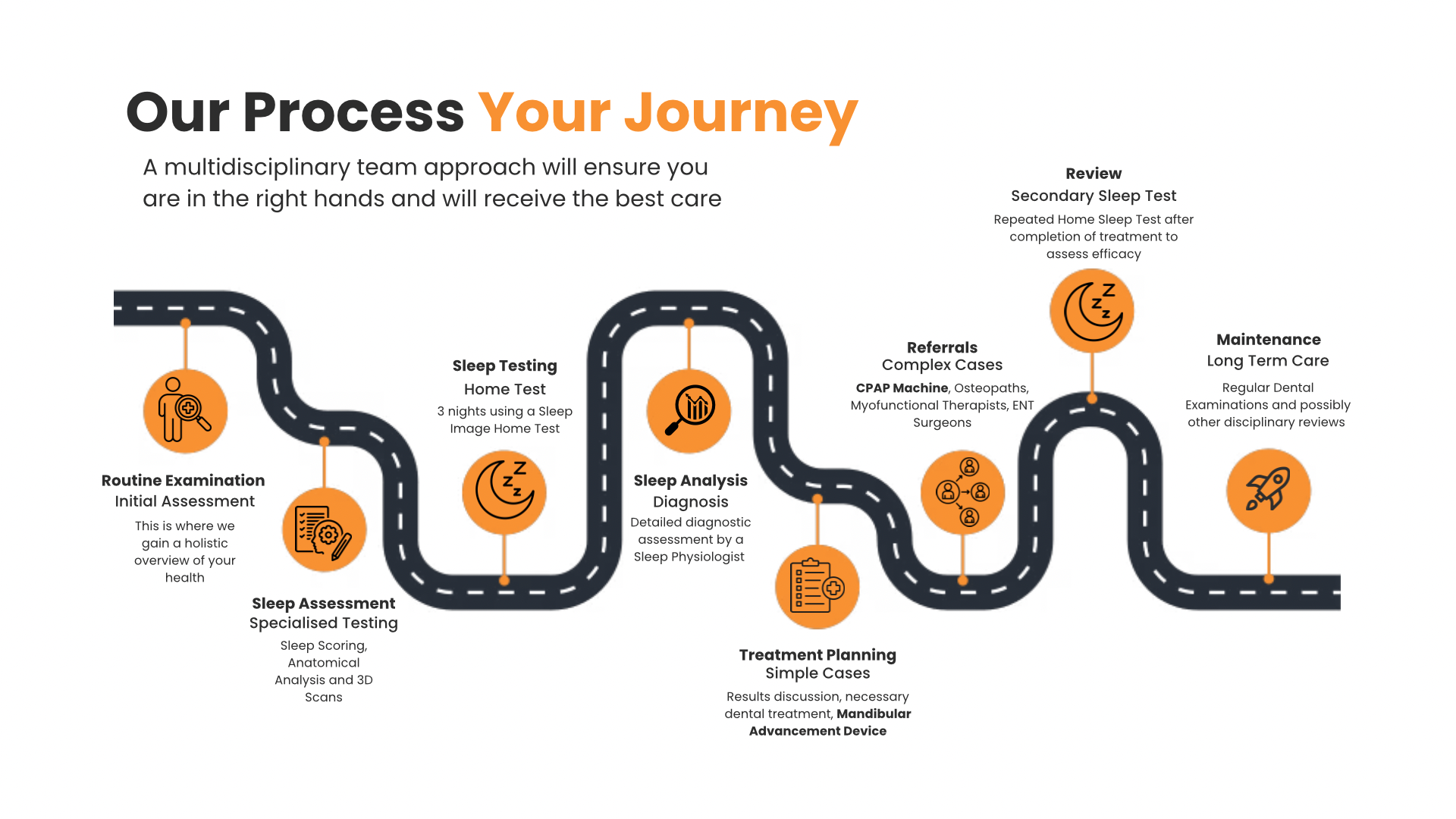
Sleep apnoea is the most common of the sleep breathing disorders, characterised by repeated episodes of complete or partial collapse of the upper airway during sleep, causing oxygen levels to drop and sleep to fragment. Dentists are uniquely placed to play a meaningful role in both the identification and management of this condition. During routine examination, a dentist can observe a range of clinical signs that may indicate an underlying airway problem — including a restricted oropharyngeal airway, enlarged tonsils, a low-lying or scalloped tongue, a high-arched or narrow palate, retrognathia, and evidence of bruxism, which is increasingly recognised as a physiological response to airway obstruction. Patients may also report relevant symptoms such as fatigue, morning headaches, or unrefreshing sleep when completing their medical history. Where sleep apnoea is suspected, dentists can refer patients for formal sleep investigation and, following diagnosis by a sleep physician, can provide Mandibular Advancement Devices (MADs) — a clinically evidenced, NICE-recognised treatment option for mild to moderate OSA and for patients who are unable to tolerate CPAP therapy. By repositioning the mandible forward during sleep, MADs work to maintain airway patency and reduce apnoeic episodes. The dental appointment therefore represents a valuable and often underutilised opportunity to identify patients who may be suffering silently, and to connect them with the care that can meaningfully improve both their sleep and their long-term health.
-
During the night:
Loud snoring
Stopping breathing during sleep
Gasping or choking during sleep
Waking up frequently
Restless sleep
Dry mouth or sore throat on waking
Needing to urinate during the night
During the day:
Extreme tiredness
Morning headaches
Poor memory and concentration
Irritability and mood changes
Feeling low or depressed
Reduced sex drive
Physical signs:
High blood pressure
Waking feeling unrefreshed despite a full night's sleep
-
Increased risk of stroke
Increased risk of heart attack
High blood pressure (hypertension)
Irregular heartbeat (arrhythmia)
Type 2 diabetes
Heart failure
Weight gain
Depression and anxiety
Memory loss and cognitive decline
Increased risk of dementia
Poor work or school performance
Relationship difficulties due to snoring and disturbed sleep
Increased risk of road traffic accidents due to daytime sleepiness
Reduced quality of life
Premature death
-
In the UK, treatment for sleep apnoea is guided by NICE and delivered through a combination of NHS and private pathways, with the approach tailored to the severity of the condition. The current gold standard treatment is Continuous Positive Airway Pressure (CPAP) therapy, which works by creating positive pressure that keeps the airway open during sleep. CPAP is typically the first treatment offered for moderate to severe OSA and is available on the NHS following a formal diagnosis from a specialist sleep clinic. For patients who struggle to tolerate CPAP, or those with mild to moderate OSA, a Mandibular Advancement Device (MAD) is a well-established alternative. A MAD is a dental appliance, similar to a gum shield, worn over the teeth during sleep; it holds the jaw and tongue forward to increase the space at the back of the throat and reduce airway narrowing, and it is recommended that it is made by a dentist with training and experience in treating sleep apnoea. MADs are not always available on the NHS, so patients may need to access this treatment privately through a dentist. Beyond these two primary interventions, lifestyle modifications play an important supporting role — including weight loss, reducing alcohol intake, stopping smoking, and improving sleep hygiene — all of which are recommended within NICE guidance. Surgical intervention is also an option for patients with a clear structural abnormality contributing to their airway obstruction, though it is typically only considered after other treatments such as CPAP or dental devices have been trialled without success. Positional therapy, which discourages sleeping on the back, may also be appropriate for patients whose OSA is positional in nature. Together, these options mean that effective, evidence-based treatment is accessible in the UK across a range of clinical presentations and patient preferences.
Enquiries
Reach out to one of our friendly, informative staff for information about our plan options, finance or anything else that will put you at ease about your visit with us.

Please let us know if you would prefer to speak in Welsh.